
The Communication Architecture AI Can’t Break Into
NEW YORK, September 27, 2026 — Great Wing today announced Wormhole™, a communication protocol built on a fundamental departure from how networked devices operate: a device does not need general internet access to communicate with authorized devices, people, applications, or networks anywhere in the world.
The Problem: Reachability Creates Exposure
The internet was designed to make devices reachable. That reachability also creates an attack surface: internet-connected systems can generally be scanned, probed, fingerprinted, and targeted.
Organizations use firewalls, segmentation, VPNs, endpoint protection, and other controls to manage that exposure. These measures are important, but they largely address the consequences of internet reachability rather than eliminating threats at the source.
This challenge is particularly significant for remote workforces, sensitive government systems, and industrial and operational technology, where connecting legacy or sensitive equipment can introduce risks that the systems were never designed to withstand.
Wormhole: A Different Architecture
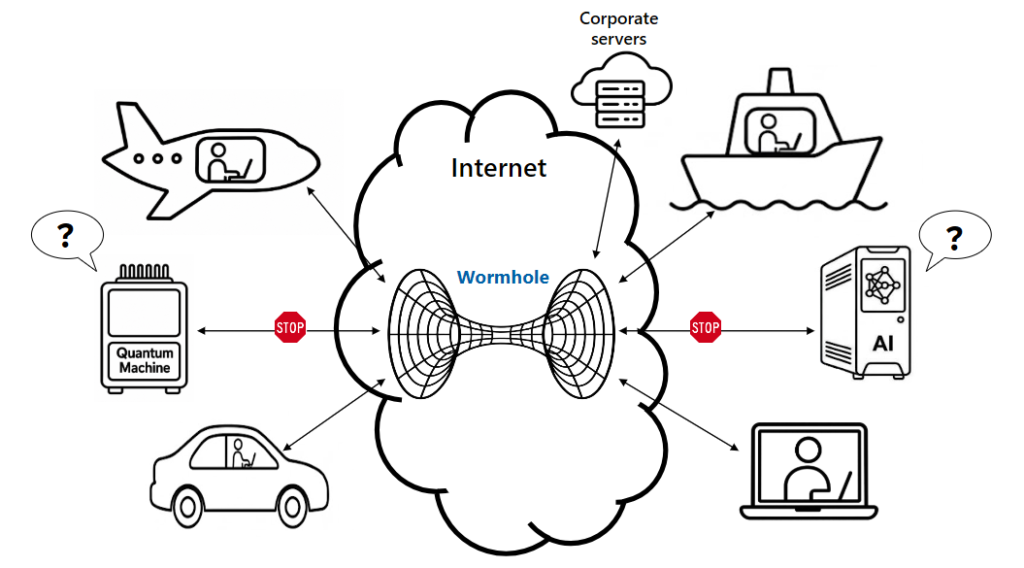
Wormhole is designed so authorized endpoints can communicate over the public internet without exposing the endpoint itself as a general-purpose internet host or conventional TCP/IP service. Wormhole-connected devices therefore do not present the fixed, addressable footprint that conventional internet scanning and reconnaissance tools rely on.
Wormhole operates above standard TCP/IP, UDP, and ICMP, and adds encryption designed to withstand future quantum attacks, along with packet-level integrity and origin verification.
No Response to Conventional TCP/IP Probing
Wormhole-connected devices do not respond to conventional internet-based TCP connection attempts, including unsolicited SYN, FIN, RST, and ACK packets. Conventional scanners therefore cannot establish a standard TCP/IP connection to a Wormhole endpoint or use such responses to identify an exposed service.
Wormhole uses dynamic, non-persistent IP addresses and port numbers rather than fixed, stable endpoints, further limiting the ability to locate or track an endpoint through conventional reconnaissance.
This extends to AI-driven scanning and intrusion tools: because systems guarded solely by Wormhole present no conventional, addressable TCP/IP footprint to probe, AI cannot break into systems that are guarded solely by Wormhole.
Encryption Designed for the Post-Quantum Era
Wormhole incorporates symmetric-key encryption designed to resist known quantum attack methods. Each device is provisioned with a unique, device-bound credential required to unlock its working encryption key, with a portion of that credential never transmitted over a network.
Working keys can also rotate frequently, limiting the exposure associated with any individual key. Discoverability and cryptographic strength provide separate defenses: one helps prevent an endpoint from being located and targeted; the other protects traffic if an adversary intercepts it and attempts to obtain or break a working key.
Packet-Level Integrity and Origin Verification
Wormhole verifies individual packets for signs of alteration or unauthorized origin, helping detect tampering, injection, and other attempts to manipulate traffic in transit. Device-level pairing further binds working keys to their authorized devices, preventing one device’s credential from being used to unlock another device’s key.
Designed to Work With Existing Infrastructure
Wormhole is designed to layer onto existing infrastructure without requiring organizations to replace hardware, rewrite software, or change established operational workflows.
Dramatically Reduces the Attack Surface
By reducing device exposure and discoverability, Wormhole is designed to reduce certain categories of cybersecurity risk and the infrastructure and operational effort required to manage them. Potential benefits include reducing reliance on some exposure-management infrastructure and decreasing the monitoring and response burden associated with reconnaissance-driven threats.
Availability
Wormhole is ready to deploy. It has been tested with 99.99% uptime.